MSC Therapy and Secretome: Two Complementary Approaches in Regenerative Medicine
Regenerative medicine is not about choosing between cells and signals—it is about understanding how to use both effectively.
Regenerative medicine is evolving rapidly, bringing new therapeutic possibilities that extend far beyond traditional treatment approaches. Among the most promising strategies are mesenchymal stromal cell (MSC) therapy and secretome-based therapies.
These approaches are often presented as alternatives. In reality, they are built on the same biological foundation and should be viewed as complementary tools rather than competing technologies.
One Biological Principle, Two Therapeutic Strategies
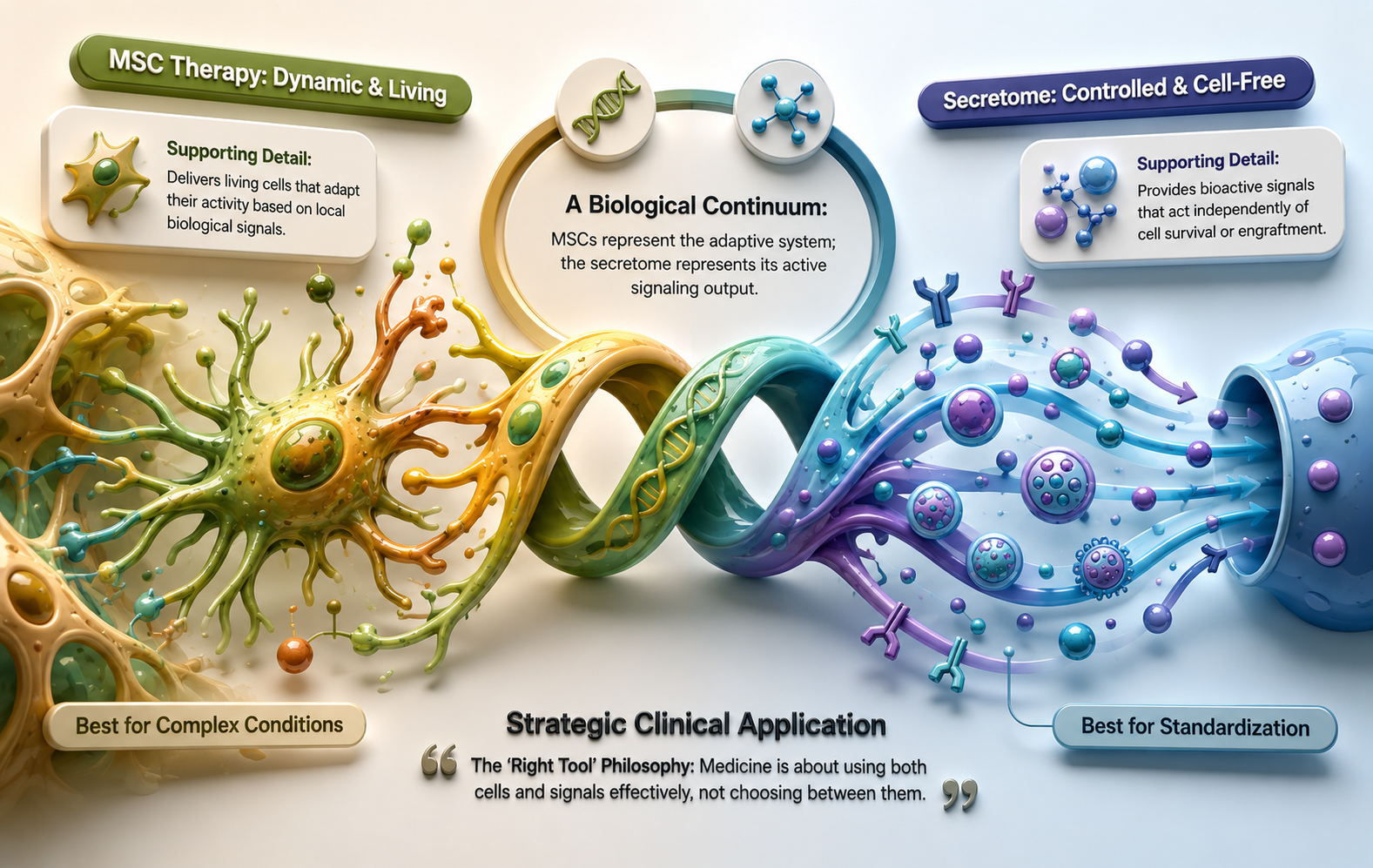
Both MSC therapy and secretome-based approaches rely on the remarkable biological properties of mesenchymal stromal cells. Rather than simply replacing damaged tissue, MSCs help regulate inflammation, support tissue repair, and restore a healthy cellular microenvironment. The key difference lies in how these regenerative effects are delivered.
MSC Therapy – Living Cells with Adaptive Potential
MSC-based therapy introduces living mesenchymal stromal cells into the body.
Because these cells remain biologically active, they continuously interact with their surrounding environment. They are capable of sensing local inflammatory signals and adjusting their biological activity accordingly, creating a dynamic and responsive therapeutic effect.
This makes MSC therapy particularly valuable in situations where tissues require ongoing biological regulation and complex regenerative support.
MSC therapy may be especially appropriate for:
- advanced or chronic degenerative conditions,
- complex inflammatory diseases,
- tissue environments requiring long-term adaptive biological responses.

Secretome Therapy – Cell-Free Biological Signaling
Secretome-based therapy takes a different approach. Instead of administering living cells, it delivers the collection of bioactive molecules naturally released by MSCs, including growth factors, cytokines, extracellular vesicles, and other signaling molecules responsible for many of the cells' regenerative effects. Because no living cells are administered, secretome therapy offers a highly controlled and standardized treatment option. Its biological activity does not depend on cell survival, engraftment, or adaptation after administration. Secretome-based approaches may be particularly advantageous for: • clinical situations where safety and reproducibility are priorities, • early-stage interventions, • repeated therapeutic applications, • patients where a cell-free strategy is preferred.
Why Both Approaches Matter
Animals biology is highly complex, and no single regenerative strategy is optimal for every patient or every clinical indication. Having access to both MSC-based and secretome-based therapies allows clinicians to tailor treatment according to: • the stage of disease, • the biological environment, • therapeutic objectives, • individual patient characteristics. This flexibility represents one of the greatest strengths of modern regenerative medicine.
A Continuum, Not a Replacement
One common misconception is that secretome therapy represents an entirely different field from MSC therapy. In fact, the opposite is true. The secretome is an integral part of MSC biology—it is the collection of biological signals through which MSCs exert many of their therapeutic effects. Rather than viewing these therapies as separate options, it is more accurate to understand them as different points along the same biological continuum: • MSCs represent the living, adaptive regenerative system. • The secretome represents the active signaling output generated by that system. Each offers distinct advantages depending on the clinical context.
Clinical Perspective
From a clinical standpoint, treatment selection should be guided by biological rationale rather than preference for one technology over another. In general: MSC therapy may be preferred when complex tissue interaction, immune modulation, and long-term adaptive responses are required. Secretome-based therapy may be advantageous when treatment standardization, predictable biological activity, or enhanced safety considerations are the primary objectives. These approaches should not be viewed as mutually exclusive. Instead, they expand the therapeutic toolbox available to regenerative medicine specialists. The Future of Regenerative Medicine The future of regenerative medicine is unlikely to depend on a single therapeutic modality. Instead, successful regenerative strategies will increasingly integrate: • cell-based therapies, • cell-free biological products, • and a deeper understanding of the molecular mechanisms that drive tissue repair and regeneration. As scientific knowledge advances, clinicians will be better equipped to select the right biological intervention for the right patient at the right stage of disease.

Conclusion
MSC therapy and secretome-based therapies are not competitors—they are complementary strategies built upon the same regenerative biology.
Understanding their respective strengths allows clinicians to make more informed, patient-centered decisions and opens the door to more personalized regenerative medicine.
Regenerative medicine is not about choosing between cells and signals—it is about understanding how to use both effectively.